Gia Macool posts Men love to get pissed at women for “poking the bear,”...
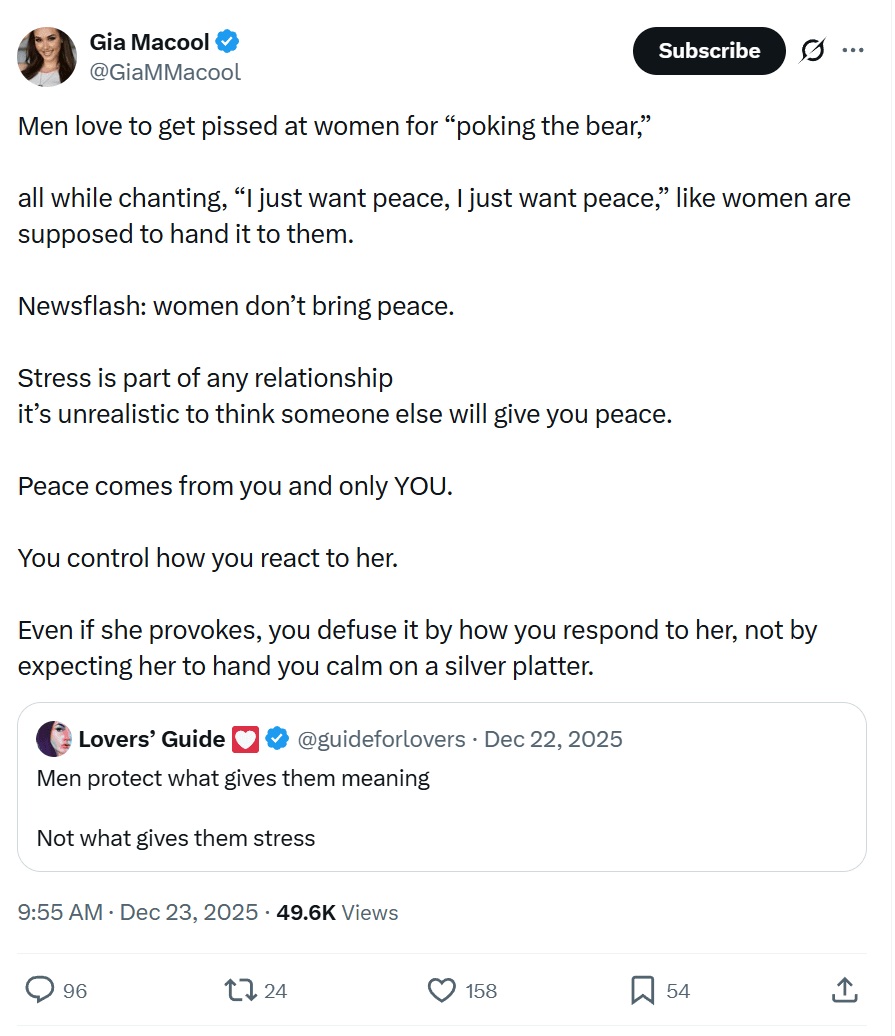
In this post, Gia Macool expresses frustration with a perceived double standard in how men and women manage conflict in relationships. She critiques men for blaming women for escalating tensions ('poking the bear') while simultaneously claiming to want a peaceful relationship. Gia argues that this expectation is unrealistic, as stress is an inherent aspect of relationships. Her narrative challenges the notion that one partner (in this case, women) should bear the burden of maintaining peace.
Thoughts
Beliefs
Selected Thought:
Men often blame women for stress in relationships.
Age Groups
Sex
Religion
Education
Political Leaning
Demographic Importance Ranking
How much each demographic category influences beliefs on this thought (0-100)
B.E.T.s
B.E.T. AI Assessments
Selected B.E.T. #1:
Population Distribution Across Categories
Estimated IQ by Category
Category Details
Male Guardian Optimist
Traditional individuals who believe men should take the lead in maintaining harmony and are confident that peaceful relationships are achievable. Often found in conservative or religious communities, they value clear gender roles and believe commitment and male leadership naturally produce stability.
Burdened Pessimist
People who place responsibility on men for peace but doubt it can truly be achieved. Often cynical individuals who have witnessed failed relationships despite male efforts. May feel men are set up to fail in an impossible task, leading to resentment or fatalism about love.
Traditionalist Agnostic
Those who accept male responsibility for relational peace but remain uncertain whether peace is realistic. Often older individuals reflecting on mixed experiences, or younger people raised traditionally but encountering modern relationship complexities.
Egalitarian Optimist
Progressive individuals who reject gendered responsibility but believe peaceful relationships are absolutely possible through mutual effort. Often educated, feminist-leaning people who see partnership as shared work and have experienced or witnessed healthy equal relationships.
Cynical Realist
Disillusioned individuals who reject male responsibility and doubt peace is possible. Often divorced or relationship-avoidant people who view conflict as inherent to intimacy. May be intellectually detached, viewing romantic idealism as naive.
Skeptical Questioner
Those who reject male responsibility but remain uncertain about whether peace is achievable. Analytical types still forming their worldview, often younger adults navigating modern dating or academics studying relationship dynamics without firm conclusions.
Hopeful Undefined
Optimistic individuals uncertain about who bears responsibility but confident peace is possible. Often emotionally intelligent people focused on outcomes over structure, believing love works out regardless of who leads. Common among spiritual but non-dogmatic types.
Confused Pessimist
Those unsure who should maintain peace and doubtful it exists anyway. Often people with chaotic relationship histories who have given up trying to understand dynamics. May struggle with attachment or have avoidant tendencies.
Open Uncertain
Genuinely undecided on both questions. Often young adults without significant relationship experience, or contemplative individuals who resist categorical thinking. May be philosophers at heart or simply disengaged from relationship discourse.
Belief Systems
Belief System #1 Structure
Legend:
Belief System AI Assessments
Selected Belief System #1:
Both partners should equally share the responsibility for maintaining peace in a relationship.
Persona Name
Harmony Harper
Profile Description
Harmony is a 34-year-old couples therapist from Portland who runs a popular Instagram account called 'Balanced Love Chronicles.' She owns an impressive collection of self-help books and has attended no fewer than twelve relationship workshops in the past three years. She frequently reminds her friends that she and her partner Derek have 'done the work' and proudly displays a framed copy of their jointly-signed 'Emotional Labor Distribution Agreement' in their kitchen. Harmony believes deeply in spreadsheets for tracking household chores and has strong opinions about the proper way to have a 'feelings check-in.' While her views on relationship equity are genuinely sound and well-reasoned, she does have an unfortunate habit of analyzing her friends' relationships uninvited over brunch.
Estimated IQ
AI model's estimate of the average IQ for someone holding this belief system