Keith Rabois reposted FCC impacts on foreign made drones
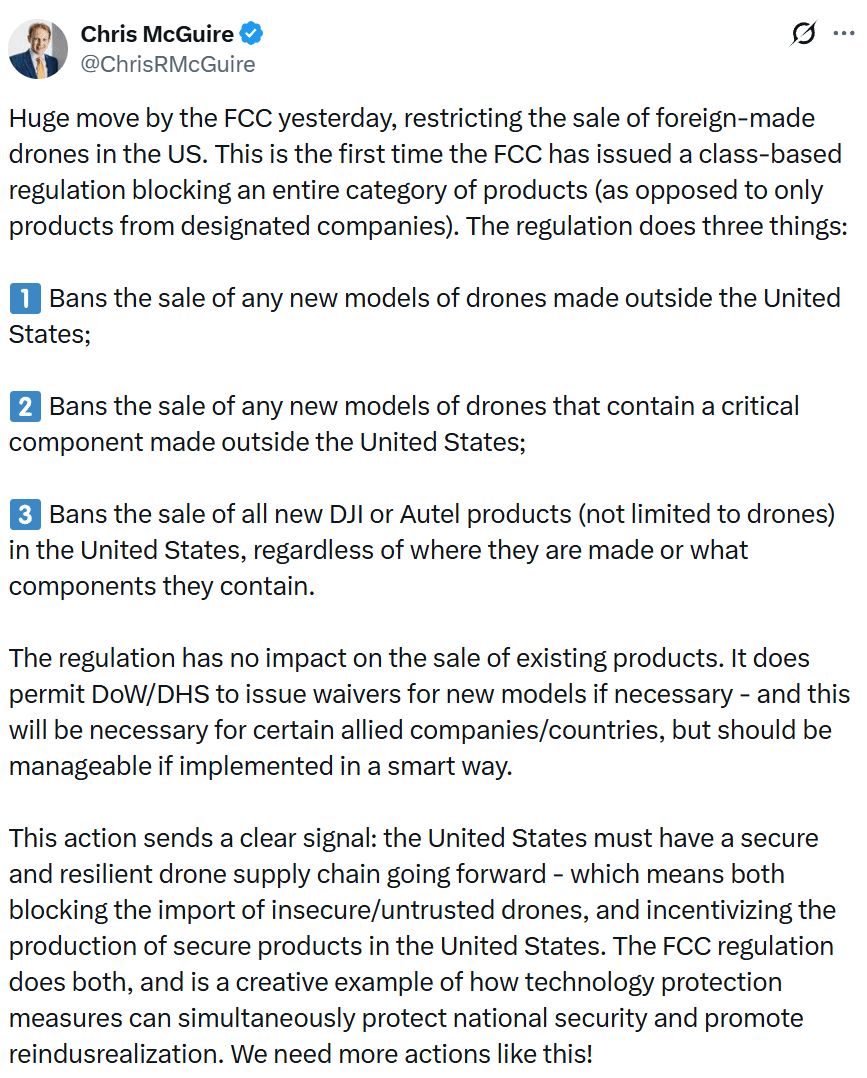
In the post, Keith Rabois highlights a significant regulatory action taken by the Federal Communications Commission (FCC) that impacts the sale of foreign-made drones in the United States. Rabois notes that this marks a historical precedent as it is the first instance where the FCC has imposed a class-based regulation that broadly targets an entire category of products rather than individual companies. This action stems from a national security determination and reflects rising tensions around foreign technology and its implications for domestic security. The FCC added foreign-produced Unmanned Aircraft Systems (UAS) and critical components to a 'Covered List,' which restricts their availability in the U.S. market, signifying a shift in regulatory practices aimed at safeguarding national interests.
Thoughts
Beliefs
Selected Thought:
The FCC's regulation on foreign-made drones is a necessary step for safeguarding national security.
Age Groups
Sex
Religion
Education
Political Leaning
Demographic Importance Ranking
How much each demographic category influences beliefs on this thought (0-100)
B.E.T.s
B.E.T. AI Assessments
Selected B.E.T. #1:
Population Distribution Across Categories
Estimated IQ by Category
Category Details
Security-Conscious Pragmatist
Believes drone regulations protect national security while recognizing regulatory overreach can stifle markets. Often moderate policy wonks, defense-minded libertarians, or business professionals who support targeted security measures but worry about bureaucratic mission creep. They seek balanced approaches that address legitimate threats without creating barriers to entry.
Security Maximalist
Strongly supports foreign drone bans and dismisses concerns about regulatory impact on innovation. Often older conservatives, defense hawks, or those with military/government backgrounds who prioritize national security above market considerations. They trust regulatory agencies to make appropriate distinctions.
Security-First Uncertain
Convinced of the national security threat from foreign drones but unsure about economic implications. Often politically engaged citizens who follow defense news but lack business or economics background. They defer to experts on market dynamics while holding firm security convictions.
Free Market Skeptic
Views drone regulations as security theater while worrying about innovation barriers. Often libertarian-leaning tech workers, entrepreneurs, or economists who see the regulations as protectionism disguised as security. They're attuned to how regulations benefit incumbents over startups.
Regulation Dismissive
Rejects both the security rationale and innovation concerns. Often politically disengaged individuals or contrarians who distrust government narratives generally. May include some who simply haven't thought deeply about either issue or reflexively oppose mainstream positions.
Security Skeptic Neutral
Doesn't buy the national security argument but remains uncommitted on innovation effects. Often younger, tech-savvy individuals who see foreign drone fears as overblown but haven't formed opinions on regulatory economics. May be casually libertarian without deep policy knowledge.
Cautious Market Defender
Uncertain about security claims but concerned about regulatory harm to competition. Often economists, startup founders, or innovation advocates who want more evidence on security threats while clearly seeing how class-based rules disadvantage smaller players.
Doubly Skeptical
Questions both the security justification and the doom-saying about innovation impacts. Often highly educated centrists or policy analysts who demand rigorous evidence before accepting either narrative. They see nuance others miss and resist ideological framing.
Genuinely Undecided
Hasn't formed opinions on either question. Includes those unfamiliar with FCC drone policy, politically disengaged citizens, or careful thinkers who feel they lack sufficient information. May be younger, less news-engaged, or simply focused on other life priorities.
Belief Systems
Belief System #1 Structure
Legend:
Belief System AI Assessments
Selected Belief System #1:
The U.S. should impose restrictions on foreign drones to ensure national security.
Persona Name
Colonel Reginald "Reg" Hawksworth III
Profile Description
A retired Air Force intelligence officer turned defense policy consultant, Colonel Hawksworth spent 28 years analyzing aerial reconnaissance systems before transitioning to the private sector. He now runs a small but influential think tank in Arlington, Virginia, where he spends his days writing white papers about supply chain vulnerabilities and attending congressional hearings. Reg genuinely wrestles with his libertarian economic instincts versus his deep-seated belief that America must maintain technological supremacy at all costs. He drives a Ford F-150 (American-made, naturally) with a 'Don't Tread On Me' bumper sticker right next to one supporting increased defense spending. His internal contradiction between free market principles and security-first nationalism keeps him up at night, though he's ultimately concluded that you can't have a free market if foreign adversaries have already compromised your infrastructure. Enjoys bourbon, Tom Clancy novels, and lecturing his nephew about the dangers of his DJI quadcopter.
Estimated IQ
AI model's estimate of the average IQ for someone holding this belief system