Keith Rabois reposted FCC impacts on foreign made drones
Keith Rabois reposted FCC impacts on foreign made drones

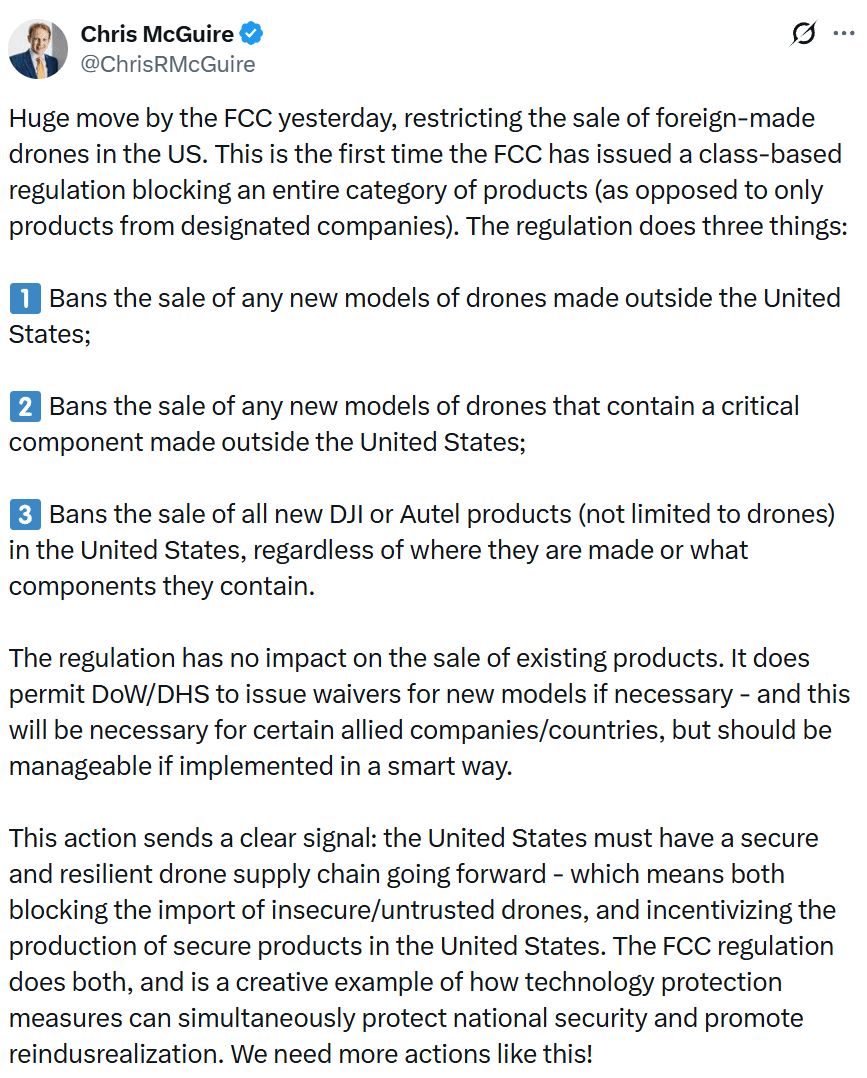
In the post, Keith Rabois highlights a significant regulatory action taken by the Federal Communications Commission (FCC) that impacts the sale of foreign-made drones in the United States. Rabois notes that this marks a historical precedent as it is the first instance where the FCC has imposed a class-based regulation that broadly targets an entire category of products rather than individual companies. This action stems from a national security determination and reflects rising tensions around foreign technology and its implications for domestic security. The FCC added foreign-produced Unmanned Aircraft Systems (UAS) and critical components to a 'Covered List,' which restricts their availability in the U.S. market, signifying a shift in regulatory practices aimed at safeguarding national interests.

Thoughts

1

The FCC's regulation on foreign-made drones is a necessary step for safeguarding national security.

Currently selected
2

Restricting foreign drones could stifle innovation within the U.S. drone industry.

3

The imposition of a Covered List for foreign UAS reflects increasing protectionism in U.S. trade policy.

4

National security concerns can justify stringent regulations impacting foreign technology.

5

Regulating foreign-made drones undermines the principles of free market capitalism.

6

Class-based regulations restrict market entry for foreign producers, harming competition.

7

A truly free market should not discriminate against foreign competitors based on national origin.

8

Government intervention in tech markets disrupts natural market dynamics and consumer choice.

9

By protecting U.S. drone manufacturers, the regulations maintain competitive edge in defense technologies.

10

Limiting foreign technology in drones decreases the risk of cyber threats to U.S. infrastructure.

11

The FCC's restrictions on foreign drones enhance national security by reducing exposure to potential espionage.

12

The regulation could lead to higher prices for consumers due to reduced competition.

Beliefs

Showing belief distributions for Thought #1: "The FCC's regulation on foreign-made drones is a necessary step for safeguarding national security."

Claude Opus 4.5

Age Groups

Under 20
45%
25%
30%
Believe: 45Disbelieve: 25Unsure: 30
20-39
50%
30%
20%
Believe: 50Disbelieve: 30Unsure: 20
40-59
60%
20%
20%
Believe: 60Disbelieve: 20Unsure: 20
60+
70%
12%
18%
Believe: 70Disbelieve: 12Unsure: 18

Gender

Male
58%
22%
20%
Believe: 58Disbelieve: 22Unsure: 20
Female
52%
18%
30%
Believe: 52Disbelieve: 18Unsure: 30

Religion

Christian
58%
18%
24%
Believe: 58Disbelieve: 18Unsure: 24
Muslim
42%
32%
26%
Believe: 42Disbelieve: 32Unsure: 26
Hindu
48%
24%
28%
Believe: 48Disbelieve: 24Unsure: 28
Buddhist
44%
26%
30%
Believe: 44Disbelieve: 26Unsure: 30
Agnostic
45%
30%
25%
Believe: 45Disbelieve: 30Unsure: 25
Atheist
40%
35%
25%
Believe: 40Disbelieve: 35Unsure: 25
Other
46%
26%
28%
Believe: 46Disbelieve: 26Unsure: 28

Education

High School
52%
18%
30%
Believe: 52Disbelieve: 18Unsure: 30
Associates
50%
20%
30%
Believe: 50Disbelieve: 20Unsure: 30
Technical Degree
48%
24%
28%
Believe: 48Disbelieve: 24Unsure: 28
Bachelor's
45%
28%
27%
Believe: 45Disbelieve: 28Unsure: 27
Master's
42%
32%
26%
Believe: 42Disbelieve: 32Unsure: 26
PhD
38%
36%
26%
Believe: 38Disbelieve: 36Unsure: 26

Political Leaning

Far Left
45%
30%
25%
Believe: 45Disbelieve: 30Unsure: 25
Slightly Left
50%
25%
25%
Believe: 50Disbelieve: 25Unsure: 25
Central
55%
20%
25%
Believe: 55Disbelieve: 20Unsure: 25
Slightly Right
70%
10%
20%
Believe: 70Disbelieve: 10Unsure: 20
Far Right
80%
12%
Believe: 80Disbelieve: 8Unsure: 12

Demographic Influence Ranking

Age
35
Sex
55
Religion
25
Education
60
Politics
85

Higher numbers indicate greater influence on belief formation (1-10 scale)

Deepseek 3.2

Age Groups

Under 20
40%
45%
15%
Believe: 40Disbelieve: 45Unsure: 15
20-39
60%
30%
10%
Believe: 60Disbelieve: 30Unsure: 10
40-59
55%
35%
10%
Believe: 55Disbelieve: 35Unsure: 10
60+
50%
40%
10%
Believe: 50Disbelieve: 40Unsure: 10

Gender

Male
50%
35%
15%
Believe: 50Disbelieve: 35Unsure: 15
Female
55%
25%
20%
Believe: 55Disbelieve: 25Unsure: 20

Religion

Christian
60%
30%
10%
Believe: 60Disbelieve: 30Unsure: 10
Muslim
55%
35%
10%
Believe: 55Disbelieve: 35Unsure: 10
Hindu
50%
35%
15%
Believe: 50Disbelieve: 35Unsure: 15
Buddhist
35%
40%
25%
Believe: 35Disbelieve: 40Unsure: 25
Agnostic
40%
35%
25%
Believe: 40Disbelieve: 35Unsure: 25
Atheist
45%
40%
15%
Believe: 45Disbelieve: 40Unsure: 15
Other
40%
35%
25%
Believe: 40Disbelieve: 35Unsure: 25

Education

High School
70%
15%
15%
Believe: 70Disbelieve: 15Unsure: 15
Associates
65%
20%
15%
Believe: 65Disbelieve: 20Unsure: 15
Technical Degree
70%
15%
15%
Believe: 70Disbelieve: 15Unsure: 15
Bachelor's
60%
25%
15%
Believe: 60Disbelieve: 25Unsure: 15
Master's
55%
30%
15%
Believe: 55Disbelieve: 30Unsure: 15
PhD
50%
35%
15%
Believe: 50Disbelieve: 35Unsure: 15

Political Leaning

Far Left
70%
20%
10%
Believe: 70Disbelieve: 20Unsure: 10
Slightly Left
75%
15%
10%
Believe: 75Disbelieve: 15Unsure: 10
Central
80%
15%
Believe: 80Disbelieve: 15Unsure: 5
Slightly Right
90%
Believe: 90Disbelieve: 7Unsure: 3
Far Right
95%
Believe: 95Disbelieve: 3Unsure: 2

Demographic Influence Ranking

Age
50
Sex
30
Religion
10
Education
60
Politics
70

Higher numbers indicate greater influence on belief formation (1-10 scale)

Gemini 3 Pro

Age Groups

Under 20
35%
30%
35%
Believe: 35Disbelieve: 30Unsure: 35
20-39
40%
35%
25%
Believe: 40Disbelieve: 35Unsure: 25
40-59
55%
25%
20%
Believe: 55Disbelieve: 25Unsure: 20
60+
65%
15%
20%
Believe: 65Disbelieve: 15Unsure: 20

Gender

Male
60%
25%
15%
Believe: 60Disbelieve: 25Unsure: 15
Female
45%
25%
30%
Believe: 45Disbelieve: 25Unsure: 30

Religion

Christian
55%
10%
35%
Believe: 55Disbelieve: 10Unsure: 35
Muslim
30%
25%
45%
Believe: 30Disbelieve: 25Unsure: 45
Hindu
40%
15%
45%
Believe: 40Disbelieve: 15Unsure: 45
Buddhist
30%
15%
55%
Believe: 30Disbelieve: 15Unsure: 55
Agnostic
35%
25%
40%
Believe: 35Disbelieve: 25Unsure: 40
Atheist
30%
30%
40%
Believe: 30Disbelieve: 30Unsure: 40
Other
35%
15%
50%
Believe: 35Disbelieve: 15Unsure: 50

Education

High School
60%
15%
25%
Believe: 60Disbelieve: 15Unsure: 25
Associates
55%
20%
25%
Believe: 55Disbelieve: 20Unsure: 25
Technical Degree
60%
15%
25%
Believe: 60Disbelieve: 15Unsure: 25
Bachelor's
50%
25%
25%
Believe: 50Disbelieve: 25Unsure: 25
Master's
45%
30%
25%
Believe: 45Disbelieve: 30Unsure: 25
PhD
40%
30%
30%
Believe: 40Disbelieve: 30Unsure: 30

Political Leaning

Far Left
25%
55%
20%
Believe: 25Disbelieve: 55Unsure: 20
Slightly Left
50%
30%
20%
Believe: 50Disbelieve: 30Unsure: 20
Central
65%
20%
15%
Believe: 65Disbelieve: 20Unsure: 15
Slightly Right
80%
10%
10%
Believe: 80Disbelieve: 10Unsure: 10
Far Right
90%
Believe: 90Disbelieve: 5Unsure: 5

Demographic Influence Ranking

Age
55
Sex
35
Religion
5
Education
45
Politics
90

Higher numbers indicate greater influence on belief formation (1-10 scale)

GPT 5.1

Age Groups

Under 20
35%
15%
50%
Believe: 35Disbelieve: 15Unsure: 50
20-39
42%
23%
35%
Believe: 42Disbelieve: 23Unsure: 35
40-59
52%
18%
30%
Believe: 52Disbelieve: 18Unsure: 30
60+
57%
13%
30%
Believe: 57Disbelieve: 13Unsure: 30

Gender

Male
42%
28%
30%
Believe: 42Disbelieve: 28Unsure: 30
Female
38%
22%
40%
Believe: 38Disbelieve: 22Unsure: 40

Religion

Christian
40%
25%
35%
Believe: 40Disbelieve: 25Unsure: 35
Muslim
25%
30%
45%
Believe: 25Disbelieve: 30Unsure: 45
Hindu
35%
20%
45%
Believe: 35Disbelieve: 20Unsure: 45
Buddhist
25%
25%
50%
Believe: 25Disbelieve: 25Unsure: 50
Agnostic
30%
30%
40%
Believe: 30Disbelieve: 30Unsure: 40
Atheist
35%
35%
30%
Believe: 35Disbelieve: 35Unsure: 30
Other
30%
25%
45%
Believe: 30Disbelieve: 25Unsure: 45

Education

High School
48%
22%
30%
Believe: 48Disbelieve: 22Unsure: 30
Associates
45%
25%
30%
Believe: 45Disbelieve: 25Unsure: 30
Technical Degree
40%
32%
28%
Believe: 40Disbelieve: 32Unsure: 28
Bachelor's
38%
32%
30%
Believe: 38Disbelieve: 32Unsure: 30
Master's
35%
35%
30%
Believe: 35Disbelieve: 35Unsure: 30
PhD
30%
38%
32%
Believe: 30Disbelieve: 38Unsure: 32

Political Leaning

Far Left
25%
50%
25%
Believe: 25Disbelieve: 50Unsure: 25
Slightly Left
35%
40%
25%
Believe: 35Disbelieve: 40Unsure: 25
Central
55%
25%
20%
Believe: 55Disbelieve: 25Unsure: 20
Slightly Right
65%
20%
15%
Believe: 65Disbelieve: 20Unsure: 15
Far Right
60%
25%
15%
Believe: 60Disbelieve: 25Unsure: 15

Demographic Influence Ranking

Age
40
Sex
30
Religion
10
Education
60
Politics
90

Higher numbers indicate greater influence on belief formation (1-10 scale)

Grok 4

Age Groups

Under 20
30%
40%
30%
Believe: 30Disbelieve: 40Unsure: 30
20-39
40%
35%
25%
Believe: 40Disbelieve: 35Unsure: 25
40-59
50%
30%
20%
Believe: 50Disbelieve: 30Unsure: 20
60+
60%
20%
20%
Believe: 60Disbelieve: 20Unsure: 20

Gender

Male
55%
25%
20%
Believe: 55Disbelieve: 25Unsure: 20
Female
45%
20%
35%
Believe: 45Disbelieve: 20Unsure: 35

Religion

Christian
65%
20%
15%
Believe: 65Disbelieve: 20Unsure: 15
Muslim
50%
30%
20%
Believe: 50Disbelieve: 30Unsure: 20
Hindu
60%
25%
15%
Believe: 60Disbelieve: 25Unsure: 15
Buddhist
45%
35%
20%
Believe: 45Disbelieve: 35Unsure: 20
Agnostic
40%
40%
20%
Believe: 40Disbelieve: 40Unsure: 20
Atheist
35%
45%
20%
Believe: 35Disbelieve: 45Unsure: 20
Other
50%
30%
20%
Believe: 50Disbelieve: 30Unsure: 20

Education

High School
65%
20%
15%
Believe: 65Disbelieve: 20Unsure: 15
Associates
60%
22%
18%
Believe: 60Disbelieve: 22Unsure: 18
Technical Degree
55%
25%
20%
Believe: 55Disbelieve: 25Unsure: 20
Bachelor's
50%
28%
22%
Believe: 50Disbelieve: 28Unsure: 22
Master's
45%
30%
25%
Believe: 45Disbelieve: 30Unsure: 25
PhD
40%
32%
28%
Believe: 40Disbelieve: 32Unsure: 28

Political Leaning

Far Left
20%
60%
20%
Believe: 20Disbelieve: 60Unsure: 20
Slightly Left
35%
45%
20%
Believe: 35Disbelieve: 45Unsure: 20
Central
50%
30%
20%
Believe: 50Disbelieve: 30Unsure: 20
Slightly Right
65%
20%
15%
Believe: 65Disbelieve: 20Unsure: 15
Far Right
80%
10%
10%
Believe: 80Disbelieve: 10Unsure: 10

Demographic Influence Ranking

Age
60
Sex
20
Religion
30
Education
40
Politics
100

Higher numbers indicate greater influence on belief formation (1-10 scale)

B.E.T.s

Click on a B.E.T. to view detailed AI assessments for that bivariate typology.
1

B.E.T. #1

Currently selected

Thought 1:

The FCC's regulation on foreign-made drones is necessary for national security

Thought 2:

Class-based regulations by the FCC could adversely affect innovation and competition

5 AI models assessed this typology
2

B.E.T. #2

Thought 1:

The U.S. should impose restrictions on foreign drones

Thought 2:

Restricting foreign drones is against the spirit of free market capitalism

5 AI models assessed this typology

B.E.T. AI Assessments

Showing AI assessments for B.E.T. #1: "The FCC's regulation on foreign-made drones is necessary for national security" vs "Class-based regulations by the FCC could adversely affect innovation and competition"

Claude Opus 4.5

Believe → Believe

BB
Name:
Security-Conscious Pragmatist
Population:
14%
Avg IQ:
112
Description:
Believes drone regulations protect national security while recognizing regulatory overreach can stifle markets. Often moderate policy wonks, defense-minded libertarians, or business professionals who support targeted security measures but worry about bureaucratic mission creep. They seek balanced approaches that address legitimate threats without creating barriers to entry.

Believe → Disbelieve

BD
Name:
Security Maximalist
Population:
18%
Avg IQ:
102
Description:
Strongly supports foreign drone bans and dismisses concerns about regulatory impact on innovation. Often older conservatives, defense hawks, or those with military/government backgrounds who prioritize national security above market considerations. They trust regulatory agencies to make appropriate distinctions.

Believe → Unsure

BU
Name:
Security-First Uncertain
Population:
11%
Avg IQ:
98
Description:
Convinced of the national security threat from foreign drones but unsure about economic implications. Often politically engaged citizens who follow defense news but lack business or economics background. They defer to experts on market dynamics while holding firm security convictions.

Disbelieve → Believe

DB
Name:
Free Market Skeptic
Population:
8%
Avg IQ:
115
Description:
Views drone regulations as security theater while worrying about innovation barriers. Often libertarian-leaning tech workers, entrepreneurs, or economists who see the regulations as protectionism disguised as security. They're attuned to how regulations benefit incumbents over startups.

Disbelieve → Disbelieve

DD
Name:
Regulation Dismissive
Population:
12%
Avg IQ:
95
Description:
Rejects both the security rationale and innovation concerns. Often politically disengaged individuals or contrarians who distrust government narratives generally. May include some who simply haven't thought deeply about either issue or reflexively oppose mainstream positions.

Disbelieve → Unsure

DU
Name:
Security Skeptic Neutral
Population:
9%
Avg IQ:
101
Description:
Doesn't buy the national security argument but remains uncommitted on innovation effects. Often younger, tech-savvy individuals who see foreign drone fears as overblown but haven't formed opinions on regulatory economics. May be casually libertarian without deep policy knowledge.

Unsure → Believe

UB
Name:
Cautious Market Defender
Population:
6%
Avg IQ:
118
Description:
Uncertain about security claims but concerned about regulatory harm to competition. Often economists, startup founders, or innovation advocates who want more evidence on security threats while clearly seeing how class-based rules disadvantage smaller players.

Unsure → Disbelieve

UD
Name:
Doubly Skeptical
Population:
7%
Avg IQ:
114
Description:
Questions both the security justification and the doom-saying about innovation impacts. Often highly educated centrists or policy analysts who demand rigorous evidence before accepting either narrative. They see nuance others miss and resist ideological framing.

Unsure → Unsure

UU
Name:
Genuinely Undecided
Population:
15%
Avg IQ:
97
Description:
Hasn't formed opinions on either question. Includes those unfamiliar with FCC drone policy, politically disengaged citizens, or careful thinkers who feel they lack sufficient information. May be younger, less news-engaged, or simply focused on other life priorities.

Deepseek 3.2

Believe → Believe

BB
Name:
Nationalist Realist
Population:
15%
Avg IQ:
113
Description:
This person believes national security justifies regulatory intervention, and is mindful that class-based approaches might stifle innovation. They see a balanced approach as possible, trusting in structured oversight to protect both security and market dynamism.

Believe → Disbelieve

BD
Name:
Security-First Pragmatist
Population:
8%
Avg IQ:
106
Description:
This person strongly supports the FCC's regulations on foreign drones as essential for national defense, but is skeptical that class-based rules would harm innovation. They prioritize security over competitive concerns, possibly seeing innovation as resilient to regulatory frameworks.

Believe → Unsure

BU
Name:
Cautious Security Advocate
Population:
12%
Avg IQ:
102
Description:
This individual firmly believes in the necessity of FCC drone regulations for national security, but is uncertain about the impact of class-based rules on innovation. They may lack detailed economic insight, focusing more on perceived threats.

Disbelieve → Believe

DB
Name:
Free-Market Skeptic
Population:
7%
Avg IQ:
110
Description:
This person disbelieves that the FCC's regulations on foreign drones are necessary for national security, perhaps viewing them as protectionist or excessive, but does believe class-based regulations could harm innovation. They likely favor minimal intervention in markets.

Disbelieve → Disbelieve

DD
Name:
Libertarian Critic
Population:
20%
Avg IQ:
108
Description:
This type is skeptical of both claims: they see the FCC's drone regulations as an unnecessary overreach that doesn't enhance security, and believe class-based rules would indeed harm innovation and competition. They advocate for deregulation across the board.

Disbelieve → Unsure

DU
Name:
Disengaged Skeptic
Population:
10%
Avg IQ:
100
Description:
This person doubts the necessity of the FCC's drone regulations for security, but is unsure about the innovation impact of class-based rules. They may have a general distrust of government action without strong convictions on the economic side.

Unsure → Believe

UB
Name:
Innovation-Conscious Agnostic
Population:
11%
Avg IQ:
105
Description:
Unsure about the national security need for drone regulations, but believes class-based rules could hinder innovation. This person may lack information on security risks but is attuned to market dynamics and technological progress.

Unsure → Disbelieve

UD
Name:
Ambivalent Observer
Population:
6%
Avg IQ:
101
Description:
Unsure about the security rationale for FCC drone rules, and disbelieves that class-based regulations harm innovation. This might reflect a person who sees regulation as generally benign or necessary, but hasn't formed a strong opinion on the specific security threat.

Unsure → Unsure

UU
Name:
Uninformed Neutral
Population:
11%
Avg IQ:
98
Description:
This person is unsure about both claims, likely due to low engagement with the topic. They may lack knowledge about drone technology, FCC regulations, or the interplay between security and innovation, leading to no firm stance.

Gemini 3 Pro

Believe → Believe

BB
Name:
The Pragmatic Realist
Population:
15%
Avg IQ:
115
Description:
This individual acknowledges the complex trade-off between geopolitical safety and market efficiency. They believe the security threat from foreign hardware is genuine and requires intervention, yet they remain cognitively dissonant, fully aware that such interventions inevitably act as a drag on technological velocity and domestic competitiveness.

Believe → Disbelieve

BD
Name:
The Security Absolutist
Population:
20%
Avg IQ:
105
Description:
This person prioritizes national sovereignty above all else. They view the FCC's actions as essential defensive measures and dismiss concerns about innovation as alarmist corporate whining. To them, a secure nation is the only foundation upon which a market can exist, and they trust American ingenuity to thrive regardless of restrictions.

Believe → Unsure

BU
Name:
The Safety-First Voter
Population:
15%
Avg IQ:
100
Description:
influenced heavily by mainstream news cycles regarding foreign espionage, this person supports the crackdown on foreign drones. They lack a specific understanding of the drone market's supply chain or economic mechanics, leading to neutrality on the question of innovation.

Disbelieve → Believe

DB
Name:
The Tech Libertarian
Population:
10%
Avg IQ:
112
Description:
Skeptical of the 'national security' card being played to disguise protectionism, this individual views the regulations as government overreach that protects inferior domestic products. They are convinced that class-based regulations will stifle the rapid iteration required for the US to remain a tech leader.

Disbelieve → Disbelieve

DD
Name:
The Institutional Skeptic
Population:
5%
Avg IQ:
102
Description:
A contrarian who distrusts both the government’s competency to assess threats and the industry’s claims of economic doom. They likely believe the security threat is manufactured for political theater, but also feel the tech industry is robust enough to ignore FCC meddling.

Disbelieve → Unsure

DU
Name:
The Geopolitical Dove
Population:
5%
Avg IQ:
104
Description:
This individual rejects the premise of the security threat, viewing it as xenophobic or diplomatically aggressive. They are undecided on the economic impact, focusing their energy entirely on opposing the security narrative rather than analyzing market consequences.

Unsure → Believe

UB
Name:
The Market Purist
Population:
10%
Avg IQ:
108
Description:
They admit they don't have the classified clearance to judge the validity of the security threat, but they hold a dogmatic belief that government regulation is inherently destructive to innovation. They default to opposing the mechanism of regulation without necessarily opposing the motive.

Unsure → Disbelieve

UD
Name:
The Bureaucratic Optimist
Population:
5%
Avg IQ:
98
Description:
This person assumes the FCC acts with professional integrity but holds no strong opinion on the specific security details. They trust that regulations are generally carefully crafted to avoid harming the industry, displaying a high faith in institutional competence.

Unsure → Unsure

UU
Name:
The Disengaged Bystander
Population:
15%
Avg IQ:
95
Description:
This individual has little knowledge of drone technology, FCC policy, or the nuances of US-Foreign relations. They are largely checked out of the regulatory discourse and have no strong intuition regarding either national security or market economics.

GPT 5.1

Believe → Believe

BB
Name:
Security-Market Balancers
Population:
10%
Avg IQ:
106
Description:
These individuals strongly support FCC restrictions on foreign-made drones as a prudent safeguard against espionage and infrastructure vulnerabilities, but they simultaneously worry that broader class-based regulations could create red tape, entrench incumbents, and stifle startup innovation. They often follow both tech and policy news, value national security, and favor targeted, narrowly tailored rules over sweeping frameworks that might chill competition.

Believe → Disbelieve

BD
Name:
Security-First Regulators
Population:
12%
Avg IQ:
102
Description:
They view foreign-made drones, especially from strategic rivals, as clear national security risks and see strong FCC intervention as essential. They tend to trust regulatory agencies to design class-based rules that will not meaningfully harm innovation and may even promote fairness and safety. Often institutionalist in outlook, they believe that well-designed regulation and technological progress can comfortably coexist.

Believe → Unsure

BU
Name:
Security-Oriented Uncertains
Population:
8%
Avg IQ:
100
Description:
They accept media and governmental narratives that foreign-made drones pose a real security threat and thus see FCC restrictions as necessary. However, they have limited familiarity with market structure or innovation dynamics and are unsure whether class-based regulations will significantly affect competition. Their views are shaped more by general trust in security arguments than by detailed knowledge of regulatory economics.

Disbelieve → Believe

DB
Name:
Free-Market Civil Libertarians
Population:
7%
Avg IQ:
108
Description:
They are skeptical that foreign-made drones present a serious or unique national security danger warranting FCC intervention, often interpreting such rules as protectionist or symbolic. At the same time, they firmly believe that class-based regulations could distort markets, favor large incumbents, and hamper innovation. They tend to emphasize open competition, minimal government interference, and technical or entrepreneurial expertise over security rhetoric.

Disbelieve → Disbelieve

DD
Name:
Threat-Skeptic Institutionalists
Population:
9%
Avg IQ:
103
Description:
They doubt that foreign-made drones pose enough of a unique risk to justify special FCC national security restrictions, often seeing existing legal tools as sufficient. Yet they are relatively confident that class-based regulations, if crafted properly, will not significantly harm innovation or competition and may help standardize safety and reliability. They usually lean pro-regulation in general, but are wary of overblown security claims.

Disbelieve → Unsure

DU
Name:
Selective Skeptics
Population:
8%
Avg IQ:
99
Description:
They are unconvinced that foreign-made drone restrictions are truly necessary, often suspecting political or economic motives behind security framing. However, they have not thought deeply about how class-based regulations shape innovation or market entry and therefore withhold judgment on those effects. Their information level is moderate: they notice policy debates but rarely dig into technical or economic details.

Unsure → Believe

UB
Name:
Innovation-Focused Cautious
Population:
6%
Avg IQ:
104
Description:
They feel they lack enough information or expertise to decide whether FCC foreign-drone restrictions are genuinely warranted, recognizing that security issues can be complex. Nonetheless, they are confident that expansive class-based regulations risk slowing innovation, raising entry barriers, and reducing consumer choice. Often connected to tech, startups, or economics discourse, they prioritize experimentation and market dynamism while remaining agnostic on specific security claims.

Unsure → Disbelieve

UD
Name:
Regulatory Optimists
Population:
10%
Avg IQ:
101
Description:
They are unsure whether foreign-made drones truly constitute a national security threat deserving special FCC action, but they generally trust that class-based regulatory schemes can be implemented without serious harm to innovation. They often believe in the state’s capacity to balance safety, fairness, and technological progress and may assume potential downsides to competition are either manageable or overstated.

Unsure → Unsure

UU
Name:
Low-Information Neutralists
Population:
30%
Avg IQ:
97
Description:
They have limited awareness of FCC drone policy debates and little exposure to detailed arguments about foreign security risks or the competitive effects of class-based regulation. Their attitudes are characterized by genuine uncertainty rather than strong convictions; they may vaguely assume that “someone is handling it” but do not feel informed enough to take a side. This group represents the broad, relatively disengaged public that rarely follows niche regulatory issues.

Grok 4

Believe → Believe

BB
Name:
Security Pragmatist
Population:
12%
Avg IQ:
115
Description:
A cautious patriot who prioritizes national defense but acknowledges the economic trade-offs, often working in tech policy with a balanced view of risks and rewards.

Believe → Disbelieve

BD
Name:
Unwavering Regulator
Population:
18%
Avg IQ:
105
Description:
Strong supporter of government oversight for safety, dismissing concerns about stifling creativity as overblown, typically found in bureaucratic or military circles.

Believe → Unsure

BU
Name:
Tentative Protector
Population:
8%
Avg IQ:
100
Description:
Believes in security measures but remains open-minded about their impact on business, perhaps a moderate voter exploring tech news sporadically.

Disbelieve → Believe

DB
Name:
Innovation Hawk
Population:
10%
Avg IQ:
120
Description:
Skeptical of security claims but worried about regulatory overreach harming markets, often entrepreneurs or libertarians advocating for free enterprise.

Disbelieve → Disbelieve

DD
Name:
Free Market Skeptic
Population:
15%
Avg IQ:
95
Description:
Rejects both security justifications and fears of economic harm, viewing regulations as unnecessary meddling, commonly anti-government activists.

Disbelieve → Unsure

DU
Name:
Doubtful Observer
Population:
7%
Avg IQ:
98
Description:
Questions the need for drone regs but is uncertain about innovation effects, maybe a casual observer of policy debates without strong opinions.

Unsure → Believe

UB
Name:
Open-Minded Alarmist
Population:
9%
Avg IQ:
110
Description:
Unsure about security benefits but convinced of potential innovation damage, possibly academics studying regulatory economics with cautious outlooks.

Unsure → Disbelieve

UD
Name:
Agnostic Deregulator
Population:
11%
Avg IQ:
108
Description:
Neutral on security but rejects innovation harm claims, often pragmatists who prefer evidence-based policy without preconceptions.

Unsure → Unsure

UU
Name:
Undecided Bystander
Population:
10%
Avg IQ:
100
Description:
Completely unsure on both fronts, representing the average citizen disinterested in drone policy, focusing on daily life instead.

Belief Systems

Click on a belief system to view detailed AI assessments for that persona.
1

Belief System #1

Currently selected

Belief Structure:

The U.S. should impose restrictions on foreign drones to ensure national security.
Believe
Restricting foreign drones minimizes the risk of espionage and cyber threats to U.S. infrastructure.
Believe
Enhancing domestic manufacturing capacity for drones strengthens national defense and technological sovereignty.
Believe
National security concerns justify stringent regulations on foreign-made technology, outweighing economic competition issues.
Believe
Restrictions on foreign drones is in conflict with free market capitalism
Believe
National security is more important than free market principles
Believe
5 AI models assessed this belief system
2

Belief System #2

Belief Structure:

The U.S. should impose restrictions on foreign drones to ensure national security.
Believe
Restricting foreign drones minimizes the risk of espionage and cyber threats to U.S. infrastructure.
Believe
Enhancing domestic manufacturing capacity for drones strengthens national defense and technological sovereignty.
Believe
National security concerns justify stringent regulations on foreign-made technology, outweighing economic competition issues.
Believe
Restrictions on foreign drones is in conflict with free market capitalism.
Disbelieve
5 AI models assessed this belief system
3

Belief System #3

Belief Structure:

The U.S. should impose restrictions on foreign drones to ensure national security.
Believe
Foreign entities like China pose significant threats to U.S. infrastructure and security.
Believe
Restricting access to foreign drones is crucial for protecting American interests and technological dominance.
Believe
National security must take precedence over any economic arguments against restrictions on foreign technology.
Believe
5 AI models assessed this belief system
4

Belief System #4

Belief Structure:

The U.S. should not impose restrictions on foreign drones to preserve free market principles.
Believe
Restrictions hinder competition, which stifles innovation and technological advancement in the drone market.
Believe
A free market encourages collaboration and exchange of ideas that lead to better products and services.
Believe
National security arguments should not infringe on free market practices, as healthy competition can coexist with security measures.
Believe
5 AI models assessed this belief system
5

Belief System #5

Belief Structure:

The U.S. should not impose restrictions on foreign drones to keep prices low for my personal use.
Believe
If restrictions are imposed, my drone costs will increase, making it harder for me to afford what I want.
Believe
Having access to cheaper foreign drones allows me to save money while still enjoying the latest technologies.
Believe
I prefer a wider selection of affordable drones; regulations would limit my choices and drive up costs unnecessarily.
Believe
5 AI models assessed this belief system

Belief System AI Assessments

Showing AI assessments for Belief System #1

Claude Opus 4.5

Persona Name

Colonel Reginald "Reg" Hawksworth III

Estimated IQ

112
Average intelligence estimate

Assessment Status

✓ Complete
AI model has evaluated this belief system

Persona Profile

A retired Air Force intelligence officer turned defense policy consultant, Colonel Hawksworth spent 28 years analyzing aerial reconnaissance systems before transitioning to the private sector. He now runs a small but influential think tank in Arlington, Virginia, where he spends his days writing white papers about supply chain vulnerabilities and attending congressional hearings. Reg genuinely wrestles with his libertarian economic instincts versus his deep-seated belief that America must maintain technological supremacy at all costs. He drives a Ford F-150 (American-made, naturally) with a 'Don't Tread On Me' bumper sticker right next to one supporting increased defense spending. His internal contradiction between free market principles and security-first nationalism keeps him up at night, though he's ultimately concluded that you can't have a free market if foreign adversaries have already compromised your infrastructure. Enjoys bourbon, Tom Clancy novels, and lecturing his nephew about the dangers of his DJI quadcopter.

Deepseek 3.2

Persona Name

Colonel Arthur 'Ironclad' Stratton (Ret.)

Estimated IQ

120
Average intelligence estimate

Assessment Status

✓ Complete
AI model has evaluated this belief system

Persona Profile

Colonel Arthur 'Ironclad' Stratton, a retired military intelligence officer, spends his days analyzing geopolitical threats while tending to his collection of vintage radios. With a sharp, disciplined mind honed by decades of service, he believes national security is the bedrock of societal stability. He often argues that 'freedom isn't free' and sees technology as a double-edged sword: a tool for progress but also a vector for espionage. His belief in stringent drone restrictions stems from firsthand encounters with cyber vulnerabilities during his career. He values technological sovereignty, viewing domestic manufacturing as a strategic imperative. Although he acknowledges the tension with free-market principles, he prioritizes security with the conviction of someone who has seen the consequences of lax defenses. In his spare time, he writes op-eds for defense journals and enjoys debating policy with his equally opinionated bulldog, Sentinel.

Gemini 3 Pro

Persona Name

Sterling "The Silo" Vance

Estimated IQ

128
Average intelligence estimate

Assessment Status

✓ Complete
AI model has evaluated this belief system

Persona Profile

A retired military logistics officer turned defense policy analyst who views global trade through the cynical lens of Realpolitik. Sterling carries a deep-seated distrust of global supply chains, viewing every foreign-manufactured microchip as a potential sleeper agent. While he intellectually respects the efficiency of free-market capitalism—and likely voted for tax cuts in the past—he operates on a strict hierarchy where national survival trumps economic liberty every time. He is the type of person who tapes over his webcam and refuses to buy smart appliances, arguing that 'technological sovereignty' is the only true currency in modern warfare.

GPT 5.1

Persona Name

Col. Mara Kensington (Ret.)

Estimated IQ

125
Average intelligence estimate

Assessment Status

✓ Complete
AI model has evaluated this belief system

Persona Profile

Mara is a methodical, security-first policy thinker with a background that likely blends military or intelligence work with exposure to technology and economics. She frames problems primarily through the lens of systemic risk and strategic vulnerability. In her worldview, the critical question is not “Does this increase consumer choice?” but “What doors does this open for adversaries, now or in a crisis?” She accepts that restricting foreign drones conflicts with free-market capitalism, which shows she’s not blind to trade-offs. Instead, she explicitly ranks values: national security sits at the top, with economic efficiency and pure free-market principles treated as important but ultimately subordinate. This hierarchical value structure points to a fairly disciplined and internally consistent belief system. Her reasoning style is precautionary and long-term. She is attuned to asymmetric risks—like espionage, supply-chain dependencies, and embedded backdoors—where a small upfront compromise can have outsized strategic consequences later. She doesn’t appear to be driven by blanket protectionism, but rather by a focused concern on critical technologies that touch infrastructure, data, and military capability. That’s why she supports boosting domestic drone manufacturing and technological sovereignty: in her mind, this is about resilience and control over key systems, not about autarky for its own sake. Mara is comfortable with strong, even heavy-handed regulation of foreign tech when she perceives intelligence or cyber threats. To her, concepts like free competition and open markets are tools to be used when safe, not sacred principles that override existential security concerns. She likely cites historical cases of supply-chain leverage and industrial espionage as justification—seeing parallels in telecoms, semiconductors, and other dual-use technologies. Socially and politically, she probably aligns with hawkish centrists or security-focused conservatives: skeptical of unfettered globalization, wary of strategic dependence on geopolitical rivals, and inclined to support state intervention in critical sectors. Intellectually, she is structured rather than speculative; she tends to prefer concrete risk models and worst-case analyses over optimistic market self-correction narratives. Overall, she’s a disciplined, national-security realist who believes that if you lose technological control of the sky, you eventually lose control on the ground as well.

Grok 4

Persona Name

Colonel Harlan "Hawk" Fortress

Estimated IQ

125
Average intelligence estimate

Assessment Status

✓ Complete
AI model has evaluated this belief system

Persona Profile

Colonel Harlan 'Hawk' Fortress is a retired U.S. Air Force officer turned national security consultant, known for his eagle-eyed vigilance against aerial threats. With a background in drone warfare and a collection of model drones in his basement bunker, Hawk passionately advocates for 'America First' tech policies. He spends his days penning op-eds on the perils of foreign gadgets, convinced that every imported quadcopter is a potential spy in disguise. Despite his love for classic rock and grilling steaks, Hawk's true jam is jamming enemy signals—figuratively, of course. His belief system stems from battlefield experiences where he saw the risks of tech vulnerabilities firsthand, leading him to prioritize ironclad security over unchecked capitalism.